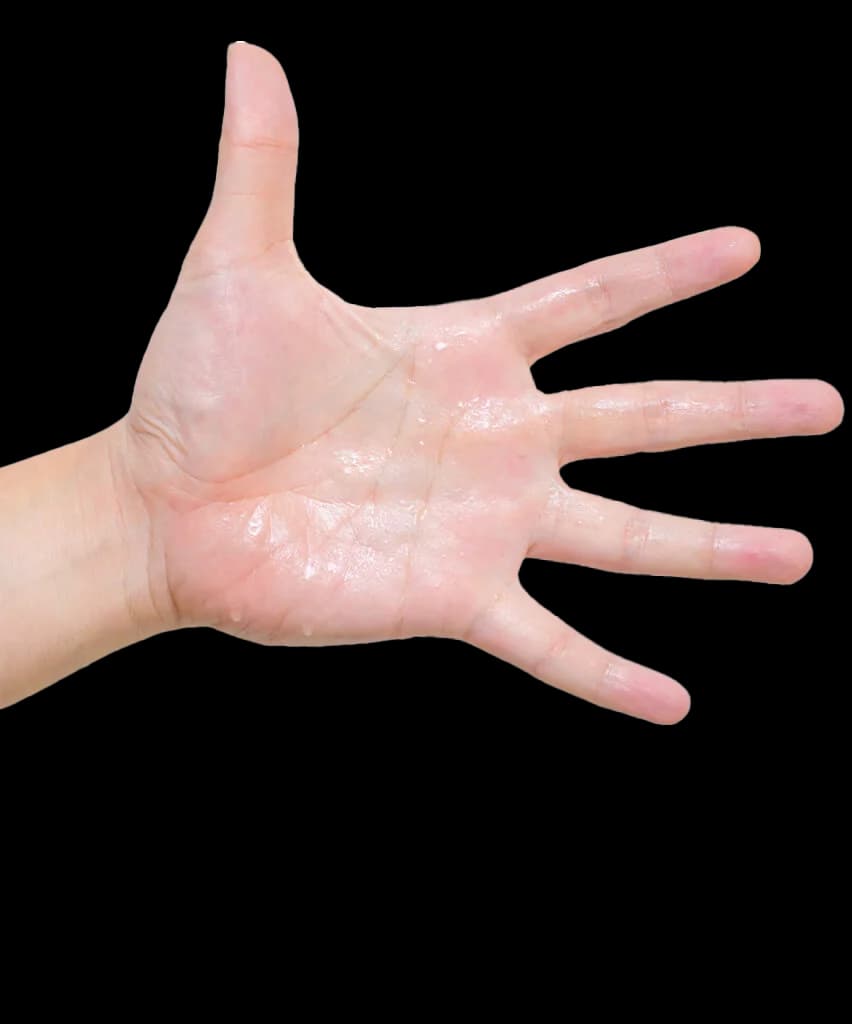
Thoracoscopic Sympathectomy (ETS)
Mini-invasive operation with sympathetic nerve transection.
Problems It Solves
Hyperhidrosis, facial redness, Raynaud's syndrome, Causalgia, Migraine.
Detailed description:
Currently, thoracoscopic sympathectomy is available for all patients who have certain problems due to high sympathetic nerve activity.
Advantages of thoracoscopic sympathectomy:
- The result is obtained immediately upon completion of the operation - the patient leaves the operating room with dry skin on the face, head, armpits, and palms.
- Two small - 5mm - incisions, with cosmetic sutures.
- Minor post-operative pain.
- Very high success rate of the operation - 98%.
- Simplicity of the operation and precise visualization through sophisticated modern technologies.
- Maximally reduced duration of the operation (30-45 min).
- Minimum rehabilitation period: 2-3 days for students and patients with office jobs.
- 7-10 days for any physical activity.
- Significant improvement in living conditions and quality, both in family and social circles.
Technique:
Thoracoscopic sympathectomy is performed in a hospital with a one-day stay. The operation on the right and left sides is performed simultaneously, under one general anesthesia. Two 5mm incisions are made under the armpit in the 3rd and 5th intercostal spaces. A 5mm endoscope is inserted into one of them, through which the chest cavity is examined and the nerve is monitored along its entire perimeter, and the necessary instrument is inserted into the second. After identifying the sympathetic nerve at the level of the second and third ribs, it is transected along a 1 cm length, and the nerve endings are treated using electrocautery. For axillary and palmar hyperhidrosis, it is necessary to transect the nerve at the level of the 2nd and 3rd ribs, while for facial hyperhidrosis or redness, only the level of the 2nd rib is sufficient. The nerve and ganglion are not excised during this operation, which significantly reduces post-operative compensatory sweating. At the end of the operation, a drain is placed in the general thoracic cavity on both sides for 2-3 hours, after which patients undergo a control chest fluoroscopy, the drains are removed, and they are discharged from the clinic on the second day. In many foreign clinics where insurance companies finance this operation (e.g., in Germany), thoracoscopic sympathectomy is performed in two stages - first on one side and then on the other - with a two-week interval. We have been performing both sides simultaneously for the last 4 years.
After the nerve is transected during the operation, the skin will be dry and warm in the areas of the face, head, armpits, and palms, and in most cases also on the soles of the feet. These changes are obtained in the operating room, immediately upon completion of the operation. Some patients experience dryness of the palms after the operation and for a certain period of time
they need to use a moisturizing ointment. Also, according to our data, approximately 4% of patients (according to international statistics, 8-12%) experience compensatory sweating, which becomes bothersome for them. Most patients note that after the operation, in addition to excessive sweating, their heart rate normalized during emotional moments. Patients also note a reduction in sweating in the soles of the feet, although this operation has no connection with sole sweating, apart from psychological factors, but it is a fact that the result is positive in most cases. In rare cases, a few years after the operation, patients report minor sweating, but they consider it normal. Due to the fact that every patient is a unique individual and has their own anatomical characteristics (additional neural branchings may be found), the possible results of surgical intervention are 95-98%.
Post-operative drying of the skin in the areas of the face, armpits, and palms, and resolution of facial redness, can become the reason for your success. Thoracoscopic sympathectomy is a modern, minimally invasive procedure with very few possible side effects, which is why its effectiveness is very high.
Thoracoscopic sympathectomy (ETS) - Associated events:
Patients must be provided with information by the doctor regarding compensatory sweating, despite its low percentage (approximately 8-10% according to international statistics). Compensatory sweating can manifest in the back, abdomen, groin, and thigh areas. It can be in mild and severe forms. According to international statistics, approximately 5% - 10% experience severe compensatory sweating. It is impossible to determine the status of compensatory sweating beforehand, as there is no possibility for pre-testing. In cases of significant compensatory sweating, there are medicinal remedies available that will significantly reduce its manifestation. Patients suffering from obesity have more pronounced compensatory sweating, as do those living in hot and humid climatic conditions. The manifestation of post-operative compensatory sweating depends not on which surgeon performed the surgical intervention, but on the method and extent of the operation performed. Gustatory sweating, which is noted during the consumption of various food products, can develop in approximately 10% of cases after the operation.
Some patients experience phantom sweating, i.e., the sensation of sweating, but this is illusory and usually resolves on its own within 1-3 weeks. It is more common in patients who have markedly pronounced complex dependencies.
Nowadays, Horner's syndrome, i.e., drooping of the eyelid, is no longer considered a complication after thoracoscopic sympathectomy, as it was caused by the transection of the sympathetic trunk at the level of the first rib, which has been removed from practice.
Contraindications for the operation:
- Previous open operation on thoracic organs.
- Severe cardiovascular insufficiency and bradycardia (pulse 60min ribs).
- Previous inflammatory diseases of the pleura (empyema, pleurisy).
- Untreated hyperthyroidism.